Which Countries Celebrate Lunar New Year is one of the most searched questions every January, and for good reason. The Lunar New Year, also known as the Spring Festival or Chinese New Year, is one of the most widely observed celebrations on the planet — stretching across China, Vietnam, South Korea, Malaysia, Singapore, Taiwan, the Philippines, Indonesia, Brunei, Bhutan, North Korea, and well beyond Asia into cities like San Francisco, New York, London, and Vancouver. It’s a festival rooted in thousands of years of history, and each country that observes it brings something distinct to the celebration. Whether you’re planning to experience it in person, travelling during the holiday period, or simply curious about the traditions, this guide covers everything. And just as Windy City Limousine Chicago ensures your travel is smooth and professionally handled no matter the occasion, understanding which countries celebrate Lunar New Year helps you plan ahead — especially if you’re travelling during one of the busiest festive periods of the year.
This guide to which countries celebrate Lunar New Year covers the origins of the festival, its key traditions, the Asian countries that observe it, and the most spectacular celebrations happening in Western cities around the world.
When Is Lunar New Year?
Unlike fixed-date holidays such as Christmas or Thanksgiving, the Lunar New Year date changes every year because it follows the lunar calendar rather than the Gregorian calendar. It can fall anywhere between January 21 and February 20, depending on the moon phases. Each year is also associated with one of 12 animals from the Chinese zodiac, each symbolising different traits and fortunes for the year ahead.
Even though China officially adopted the Gregorian calendar like most of the world, the lunar calendar still plays a significant role in everyday life — many traditional festivals, events, and even birthday calculations continue to follow it.
The History of Lunar New Year — From Ancient China to the World
The history of the Lunar New Year festival stretches back over 3,000 years. Its earliest roots are traced to the Shang Dynasty (1600–1046 BCE), when communities celebrated the arrival of spring and the renewal of life after the cold winter months. Over time, the festival became intertwined with legends, mythology, and cultural rituals that gave it the shape it holds today.
During the Han Dynasty (202 BCE–220 CE), the celebration became more structured. Emperors established official start dates, and festivities expanded to include performances, culinary traditions, and public ceremonies. What began as a regional Chinese observance gradually spread across East Asia and eventually to Chinese diaspora communities around the globe, becoming one of the most widely celebrated cultural festivals in the world.
The Legend Behind Lunar New Year — The Story of Nian
Many of the most recognisable Lunar New Year traditions trace back to a single legend: the story of Nian. Nian was a mythical creature — said to have the body of a bull and the head of a lion — that terrorised villages each year, devouring harvests, livestock, and children.
The villagers eventually discovered Nian’s weaknesses: the colour red, fire, and loud sounds. Armed with this knowledge, they decorated their homes in red, lit fires, and made as much noise as possible to drive the beast away. This legend is the direct origin of three of the festival’s most iconic customs — wearing red during Chinese New Year, setting off firecrackers, and performing the lion dance.
Key Traditions of the Lunar New Year Festival
The Colour Red and Red Envelopes
Red dominates the Lunar New Year colour palette because it symbolises good luck, happiness, and prosperity. People wear red clothing, hang red lanterns, and display red decorations with gold detailing throughout their homes. One of the most beloved traditions is the giving of red envelopes (hongbao) — small packets containing money, given by married adults to children and unmarried relatives as a wish for good fortune in the year ahead. Black and white are avoided during this period, as both colours are traditionally associated with mourning.
Reunion Dinner
The reunion dinner, known in Chinese as tuan nian fan or nian ye fan, is the most important meal of the year. Families travel from near and far to gather on the eve of the new year for a feast that carries deep symbolic meaning. Common dishes include dumplings (representing wealth), fish (surplus), noodles (longevity), chicken (happiness), and spring rolls (prosperity). The meal is followed by fireworks at midnight, the exchange of red envelopes, and watching the New Year Gala broadcast.
House Cleaning Before the Festival
In the days leading up to Lunar New Year, families thoroughly clean their homes to sweep away the misfortune of the previous year and make space for good luck to enter. Interestingly, sweeping, throwing out rubbish, or pouring water outside the house is avoided on New Year’s Day itself — doing so is believed to wash away the newly arrived fortune.
The Lion Dance and Dragon Dance
Two of the most visually striking Lunar New Year traditions are the lion dance and the dragon dance, both performed to bring good luck and drive away evil spirits.
The lion dance features two performers inside a shaggy costume, imitating the movements of a lion — an animal regarded in Chinese culture as a symbol of power and courage. The performance is brisk and energetic, often incorporating acrobatics and martial arts, accompanied by drums, gongs, and cymbals.
The dragon dance requires a team of performers to manipulate the long, decorated body of a Chinese dragon — a mythical creature representing wisdom and prosperity. The dance is more fluid and graceful than the lion dance, requiring coordination and timing. Both performances are a highlight of street celebrations across Asia and in Chinese communities worldwide.
Which Countries Celebrate Lunar New Year in Asia
China
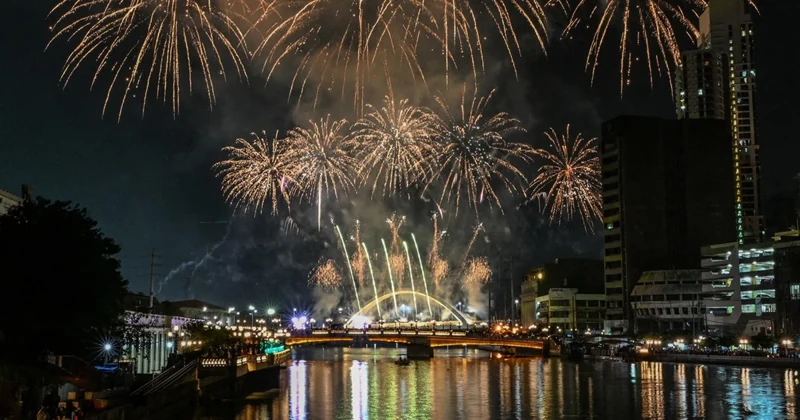
In China, the Lunar New Year (Guo Nian) is a 15-day national celebration and the most significant holiday of the year. Streets fill with red and gold decorations, families reunite for feasts of dumplings, fish, and niángāo (rice cake), and fireworks light up the sky at midnight on New Year’s Eve. Traditional activities include lion dances, lantern shows, temple fairs, and riddle games. The celebration concludes with the Lantern Festival on the 15th day, when people light lanterns, eat sweet dumplings, and watch fireworks displays.
South Korea
In South Korea, the Lunar New Year is called Seollal — a three-day public holiday centred on family reunions and ancestral rites. Families gather to offer food, incense, and prayers to departed loved ones before sharing a reunion meal. The centrepiece dish is tteokguk, a savoury rice cake soup that symbolises a fresh start and gaining a year of age. Families also wear hanbok, the traditional Korean dress, adding colour and cultural pride to the festivities. Folk games and gift exchanges complete the celebration.
Vietnam
In Vietnam, the Lunar New Year is known as Tet Nguyen Dan — the most important and festive occasion in the Vietnamese calendar. Preparations begin weeks in advance, with families cleaning their homes, buying new clothes, cooking special dishes, and purchasing flowers. A kumquat tree or peach blossom is traditionally placed in a prominent position in the home, symbolising prosperity, health, and happiness. The celebration spans three days, with visits to temples, ancestral offerings, lion dances, and flower markets all playing a central role.
Malaysia
Malaysia’s Lunar New Year celebrations reflect the country’s extraordinary cultural diversity. For Chinese Malaysians, the 15-day festival is a time of reunion dinners, red envelope exchanges, and customs like settling debts and wearing red to attract good fortune. A unique Malaysian tradition is yee sang — a colourful raw fish salad tossed at the dinner table for luck. The festival ends with Chap Goh Mei, Malaysia’s own version of the Lantern Festival, when streets are lit with colourful lanterns and some celebrate by throwing Mandarin oranges into the sea as a wish for a good future.
Singapore
Singapore’s Chinese New Year festivities last 15 days and reflect the city-state’s multicultural character. The annual Chingay Parade is one of the highlights — a spectacular street parade featuring colourful floats, cultural dance troupes, and performances from Malay, Indian, and Eurasian communities alongside Chinese traditions. The River Hongbao carnival draws crowds for cultural performances, games, and fireworks. Common traditions across the Singaporean Chinese community include spring cleaning, reunion dinners, and visiting relatives with Mandarin oranges and red envelopes.
Taiwan
Taiwan observes a 16-day Lunar New Year festival, widely considered the most important celebration on the Taiwanese calendar. Traditions share much with mainland China — red lanterns, ancestral offerings, red envelopes, and firecrackers — but Taiwan adds its own culinary twist, with pineapple cakes and dishes featuring daikon radish featuring prominently on festive tables. Temple visits are a central part of the celebration, with families praying for blessings and good fortune at Buddhist and Taoist temples throughout the holiday period.
Which Countries Celebrate Lunar New Year in the Western World
San Francisco, USA
The San Francisco Lunar New Year Festival and Parade dates back to 1851, making it the oldest Lunar New Year parade outside of Asia. The two-week festival features flower markets, street fairs, cultural performances, and fireworks, culminating in a grand parade that winds through Chinatown with colourful floats, marching bands, acrobats, and the famous 268-foot-long Golden Dragon operated by over 100 people.
New York City, USA
New York City’s Chinatown is home to one of the largest Chinese populations in the world, and its Lunar New Year celebration draws over half a million spectators annually. The firecracker ceremony at Sara D. Roosevelt Park kicks off the festivities, followed by a parade through Chinatown, Little Italy, and the Lower East Side featuring lion dancers, dragon dancers, musicians, and floats.
Los Angeles, USA
Los Angeles hosts the historic Golden Dragon Parade — a century-old tradition that predates even the Hollywood sign. The parade moves along North Broadway with floats, marching bands, and elaborate costumes, accompanied by a festival offering food, crafts, entertainment, and cultural exhibits.
Vancouver, Canada
Vancouver’s large and vibrant Chinese community celebrates with the LunarFest Spring Festival Parade, featuring lion dances, cultural dance troupes, and martial arts performances that move from the Millennium Gate through Chinatown, drawing large crowds of locals and visitors alike.
Manchester, UK
As home to one of the UK’s oldest and largest Chinese communities, Manchester marks the Lunar New Year with a colourful multi-day festival featuring lantern making, calligraphy workshops, food stalls, live music, and a parade with lion and ribbon dances, Chinese Opera performers, and giant Buddha dolls.
Travel Smart During the Lunar New Year Period
The Lunar New Year is one of the busiest travel periods of the year across Asia and in major cities worldwide. Roads, airports, and public transport fill up quickly, and planning ahead — especially for airport transfers and city travel — makes a genuine difference. Reserve your professional chauffeur with Windy City Limousine Chicago for seamless, on-time travel during the festive season, whether you’re heading to an airport, a celebration, or a corporate event.
10 Frequently Asked Questions About Lunar New Year
1. Which countries celebrate Lunar New Year? The main countries that celebrate Lunar New Year include China, Vietnam, South Korea, Malaysia, Singapore, Taiwan, the Philippines, Indonesia, Brunei, Bhutan, and North Korea. Large diaspora communities in the United States, Canada, the United Kingdom, and Australia also observe the festival with major public celebrations.
2. What is the difference between Lunar New Year and Chinese New Year? Lunar New Year is the broader term referring to the start of a new year based on a lunar calendar, observed across multiple Asian cultures. Chinese New Year specifically refers to the celebration as observed in Chinese culture and tradition. The two terms are often used interchangeably but are not exactly the same.
3. When does Lunar New Year take place? The date changes each year according to the lunar calendar and can fall anywhere between January 21 and February 20. It is always tied to the second new moon after the winter solstice.
4. How long does Lunar New Year last? In China, the official festival spans 15 days, ending with the Lantern Festival. Taiwan observes 16 days. Vietnam’s Tet celebration is three days. The duration varies by country and cultural tradition.
5. Why is red the colour of Lunar New Year? Red symbolises good luck, happiness, and prosperity in Chinese culture. Its use in Lunar New Year decorations and clothing also traces back to the legend of Nian, where the colour red was used to frighten away the mythical beast.
6. What are red envelopes and who gives them? Red envelopes (known as hongbao in Chinese or ang pow in Southeast Asia) are small packets containing money given as gifts during Lunar New Year. They are traditionally given by married adults to children and unmarried relatives as a symbol of good luck and blessings for the new year.
7. What foods are eaten during Lunar New Year? Traditional Lunar New Year foods carry symbolic meaning. Dumplings represent wealth, fish symbolises surplus, noodles represent longevity, spring rolls symbolise prosperity, and rice cake (niángāo) is associated with rising fortune. Specific dishes vary by country and region.
8. What is the significance of the lion and dragon dance? Both dances are performed to bring good luck and drive away evil spirits. The lion dance is energetic and based on the lion as a symbol of power and courage. The dragon dance is more fluid and represents wisdom and prosperity. Both are central features of Lunar New Year street celebrations worldwide.
9. Is Lunar New Year celebrated outside of Asia? Yes — Lunar New Year is celebrated in cities around the world with significant Chinese and broader Asian diaspora communities. Major celebrations take place in San Francisco, New York City, Los Angeles, Vancouver, London, Sydney, and Manchester, among many others.
10. What is the Lantern Festival and how does it relate to Lunar New Year? The Lantern Festival marks the final day of the Lunar New Year celebrations, observed on the 15th day of the new year. People light lanterns, guess lantern riddles, eat sweet rice dumplings (tangyuan), and watch fireworks. It is considered the symbolic close of the festive period.